Table of Contents
- Why Traditional Tracking Falls Short
- What AI Actually Adds to Student Progress Tracking
- Seeing the Classroom Through Data
- Building Teacher Confidence with AI Insights
- Making It Work in Real School Settings
- The Future of Continuous Learning Improvement
- From Guesswork to Guided Action
- Frequently Asked Questions
1. Why Traditional Tracking Falls Short
Most schools already track progress through report cards and classroom observations. Yet somewhere between paper records and teacher intuition, early warning signs get lost.
In several workshops that IITED has conducted with school teams, teachers often share a similar frustration: “We know some students are slipping, but we realise it only after the second term.” It’s not about lack of care — it’s about visibility.
Term-end analyses often arrive too late. Schools depend on cumulative averages rather than live feedback, leaving teachers with limited chances to intervene in time. The real challenge is not tracking itself, but tracking continuously and meaningfully.
2. What AI Actually Adds to Student Progress Tracking
AI brings precision to what teachers already sense. Instead of sifting through dozens of notebooks or spreadsheets, AI platforms can highlight subtle trends across classes or terms.
When schools supported by IITED piloted adaptive learning tools, they noticed a powerful shift: teachers could identify struggling learners as early as week three, rather than after a mid-term exam. That early detection meant smaller gaps, less stress, and stronger outcomes for both students and teachers.
Specifically, AI tools can:
- Analyse patterns in daily responses or quiz scores to identify learning plateaus.
- Detect when engagement drops, prompting early teacher action.
- Recommend targeted practice, not based on grade averages but on each learner’s pattern of mastery.
The goal is not to predict failure, but to enable timely support.
3. Seeing the Classroom Through Data
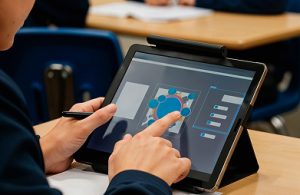
In one IITED classroom observation study, we noticed how differently teachers interpret progress once data is visualised in simple ways. A colour-coded report showing a student’s grasp of fractions week by week led to deeper discussions about teaching methods, not just student scores.
Data changes perspective. It helps schools look beyond “who scored what” to “what helped them learn.” When such insights are consolidated at the school level, academic heads can redesign lesson plans, pacing, or grouping strategies more confidently.
One school leader commented that this shift helped them “see the classroom through data, not spreadsheets.” That’s the kind of reframing AI makes possible.
4. Building Teacher Confidence with AI Insights
Teachers often worry that data-driven systems might judge their practice. But when implemented empathetically, AI builds confidence instead of anxiety.
IITED facilitators have seen this first-hand during teacher development sessions. When teachers view AI reports framed around student progress journeys, not teacher performance metrics, they are more willing to experiment with new strategies.
Simple, accessible dashboards — those that use everyday language instead of jargon — make the biggest difference. The insight needs to feel like a trusted aide, not a corporate report.
5. Making It Work in Real School Settings
For many schools, the real test isn’t technology—it’s culture. New tools fail when they feel forced into daily routines. Successful integration starts with an academic purpose, not a procurement checklist.
IITED has guided several partner schools through phased adoption: beginning with a single grade or subject, reviewing outcomes, and expanding gradually. This small-start strategy allows teachers to form habits before data overwhelms them.
Key elements to focus on:
- Begin with a priority area (e.g., reading progress or numerical fluency).
- Choose tools that fit your assessment rhythm.
- Set aside monthly reflection time to translate insights into action.
It’s a cycle of improvement, not a compliance exercise.
6. The Future of Continuous Learning Improvement
AI’s next leap in education is not more analytics — it’s context-aware feedback. Imagine systems that read classroom rhythm as sensitively as teachers do, adjusting content pacing or grouping automatically.
The institutions collaborating with IITED on AI-based interventions are already exploring such possibilities. Their focus isn’t on automation, but augmentation — giving every student a learning map visible to both teacher and parent.
This kind of visibility will reshape how schools define progress. Instead of snapshots, it will be continuous storytelling — one where success looks like growth observed together.
7. From Guesswork to Guided Action
AI’s true strength lies in making learning visible. Schools that use these insights move from reactive evaluation to proactive guidance. And when teachers, leaders, and AI work in rhythm, learning outcomes stop being a mystery — they become measurable journeys of progress.
8. Frequently Asked Questions
- How can small schools adopt AI tracking affordably?
Start by integrating lightweight analytics tools that align with your assessment patterns. IITED often recommends pilot models before large-scale adoption. - Will AI make teachers redundant?
No. AI assists by reducing manual analysis so teachers can focus on meaningful instruction and student contact. - Which kind of data works best for AI tools?
Frequent, low-stakes assessments and activity metrics help AI detect patterns faster than high-stakes exam data. - How can schools ensure teachers trust AI insights?
Transparency helps. At IITED, we’ve learned that teachers trust systems they understand and can interpret confidently in their context. - What about data privacy and safety?
Schools must ensure tools comply with standard security norms—encrypted data, anonymised reports, and clearly defined access permissions. - Where can school leaders get structured help with AI implementation?
IITED works with schools to co-design data-informed teaching frameworks that fit their existing curriculum goals and professional development plans.