Being a teacher is incredibly rewarding. You get to shape how a classroom full of children learn, grow and see the world around them, and it’s a field almost anyone with genuine passion for mentoring can break into. But mastering the most common teacher interview questions is often what stands between you and that perfect position, and in 2026, one thread runs through nearly every panel: AI teacher interview questions.
A typical teacher interview happens at the school you’re applying to, with anywhere from one interviewer to a full panel, depending on the role. What’s changed lately is what that panel asks. Alongside the usual questions on classroom management and lesson delivery, most schools now expect teachers to speak comfortably about AI, how they use it, and where they draw the line.
This guide covers the AI interview questions for teachers that schools are actually asking right now, organised by theme, plus a simple framework for answering them with confidence. Think of it as your one-stop set of teacher interview questions bank for 2026, covering both the standard teaching interview questions and the AI-specific ones now layered on top.
Modern panels also probe your instructional philosophy, classroom management, assessment skills and reflective practice. AI questions asked in teacher interviews fit right into that last one, a genuine marker of whether you’re keeping pace with how classrooms actually run today, not a gimmick thrown in to catch you off guard.

Why is it Important to Ask AI Questions during Teacher Interviews?
AI usage is no longer a choice in Indian schools. Moreover, in January 2027 itself, an AI survey concluded that around 75% of teachers opt for AI applications in their work, despite not having received extensive training.
This trend is reinforced by policies. Starting from the academic year 2026-2027, AI and computational thinking should be considered an integral part of the curriculum for students from class 3 to class 12, according to the NEP 2020 requirements. CBSE schools already include AI in the curriculum as part of skill subjects. Hence, school teacher interview questions related to AI are not frivolous nowadays.
What AI Skills Should Teachers Know Before an Interview?
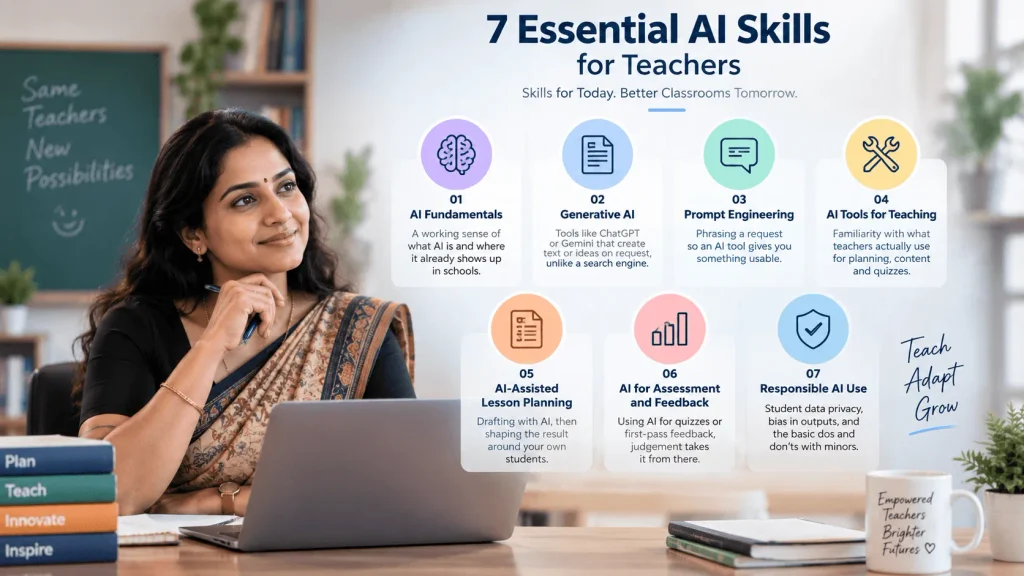
Interviewers rarely want a textbook definition when they ask AI questions for teachers or any interview questions for teachers about AI. They want to know you can apply these seven areas in a real classroom, not just define them:
- AI Fundamentals: a working sense of what AI is and where it already shows up in schools.
- Generative AI: tools like ChatGPT or Gemini that create text or ideas on request, unlike a search engine.
- Prompt Engineering: phrasing a request so an AI tool gives you something usable.
- AI Tools for Teaching: familiarity with what teachers actually use for planning, content and quizzes.
- AI-Assisted Lesson Planning: drafting with AI, then shaping the result around your own students.
- AI for Assessment and Feedback: using AI for quizzes or first-pass feedback, judgement takes it from there.
- Responsible AI Use: student data privacy, bias in outputs, and the basic dos and don’ts with minors.
50+ AI Teacher Interview Questions and Answers
AI interview questions for teachers with answers, organised by theme so you can focus on what’s relevant to your role, whether you’re prepping general school teacher interview questions or the more advanced AI in education questions for teachers.
Basic AI Questions for Teachers
Start here if you want the foundational AI teacher interview questions before anything specific.
Q. How can teachers use ChatGPT?
A. For drafting lesson plans, quiz questions or activity ideas, always reviewed before use.
Q. What is prompt engineering?
A. Writing clear, specific instructions so an AI tool gives you something usable.
Q. How would you create a lesson plan with ChatGPT?
A. Give it the topic, grade and objective, then edit the output to fit my class.
Q. What are the limitations of generative AI?
A. It can sound confident while being wrong, and knows nothing about your specific students.
Q. How do you verify AI-generated information?
By cross-checking it against the textbook or a reliable source, like any other resource.
Q. Can AI replace teachers?
A. No. It can support planning and admin work, not mentorship or real relationships.
Q. What’s the difference between AI and a search engine?
A. A search engine points you to existing information. Generative AI creates new content, which is why it needs checking.
AI Assessment & Lesson Planning Questions
More teacher interview questions and answers, this time on how AI fits into grading and planning.
Q. How can AI help with assessments?
A. By drafting question banks or quizzes quickly, which I then review for accuracy.
Q. How would you use AI for quiz creation?
A. Generate a first set of questions, then edit for difficulty and alignment with what was taught.
Q. How does AI help with question generation?
A. It produces multiple question types quickly, MCQs, short answer, application-based, saving time before exams.
Q. Can AI support differentiated assessments?
A. Yes, by generating versions of the same assessment at different difficulty levels.
Q. How can AI improve student feedback?
A. By flagging common errors or drafting first-pass comments I then personalise.
Q. How would you use AI for formative assessment?
A. Quick check-for-understanding quizzes during a lesson, so I can adjust in real time.
Q. Would you trust AI to grade student work?
For objective questions, yes, with spot checks. For written work, it supports grading, not final calls.
AI Ethics & Responsible Use Questions
Some of the trickiest AI questions asked in teacher interviews land here, ethical practice is just as important as tool knowledge.
Q. How do you protect student privacy when using AI tools?
A. By never entering identifiable student data into AI platforms, only school-approved tools.
Q. How would you handle AI-generated plagiarism?
A. A private conversation with the student first, treated as a teaching moment on honesty.
Q. What does responsible AI use look like for a teacher?
A. Checking outputs, protecting student data, and never letting AI replace your own judgement.
Q. What is bias in AI, and why does it matter in education?
A. AI reflects biases in its training data, which can skew fairness if outputs aren’t reviewed.
Q. What’s an appropriate way to let students use AI?
A. Clear guidelines on when it’s allowed, transparency about its use, focus on learning and not shortcuts.
Q. What information should teachers never share with an AI tool?
A. Student names, contact details, or any personal or identifiable information.
Q. How would you talk to students about using AI responsibly?
A. Set clear expectations early and model good habits, rather than just laying down rules.
Q. Should schools have a written AI use policy?
A. Yes. It protects students and teachers and keeps expectations consistent.
Scenario-Based AI Interview Questions
These school teacher interview questions trade definitions for real situations you might actually face.
Q. A student submits an assignment that appears to be AI-generated. What would you do?
A. Talk to the student privately, ask them to walk me through their thinking, and treat it as a teaching moment.
Q. AI generates incorrect information for your lesson. How would you handle it?
A. I’d catch it during my own review, since I always verify AI output before using it in class.
Q. Your school asks teachers to start using AI. How would you introduce it?
A. Gradually, starting with low-risk tasks like planning support, alongside clear guidelines.
Q. A parent thinks AI will replace teachers. How would you respond?
A. I’d explain AI supports planning and admin work, but not the mentorship where real learning happens.
Q. How would you use AI to support students with different learning levels?
A. Generate differentiated material at varying levels, then adjust based on actual progress.
Advanced AI Questions for Teacher Interviews
A few AI questions for school teacher interviews at the senior end, for coordinator or leadership-track roles:
Q. What does AI literacy mean for a teacher?
A. Understanding how to use AI tools, plus their limits and appropriate role in a classroom.
Q. How would you use AI in instructional design?
A. To structure a unit and sequence objectives, then refine it around my students’ needs.
Q. How does AI support competency-based education?
A. By tracking progress against specific skills and adjusting pace, instead of moving the whole class together.
Q. How would you evaluate whether an AI tool is worth using in class?
A. Its accuracy, data privacy practices, and whether it actually saves time without hurting learning.
Q. How would you approach integrating AI across a school year?
A. Starting small with planning support, then building student-facing use gradually.
Q. Where do you see AI in education heading?
A. More personalised learning, less admin load, and the teacher’s role tilting further toward mentorship.
Q. How would you build AI literacy in your students?
A. Teach them to question AI outputs and verify facts, not just accept them.
Q. What’s one AI skill you’re still working on?
A. Pick something real, like writing faster, more precise prompts, and say how you’re building it.

How Should Teachers Answer AI-Related Interview Questions?
Most teachers know enough about AI, they just don’t structure the answer. If you’re wondering how to prepare for a teacher interview once AI comes up, one approach works for almost every question above: understand the concept, explain it simply, back it with a real classroom example, then mention how you’d use it responsibly.
Take “how would you use AI for lesson planning?” A flat answer just names a tool. A stronger one shows the thinking: what the tool’s good for, a specific instance, and the guardrail that you’d still check and adapt the output before using it. That last part matters more than most candidates realise. Interviewers aren’t only checking whether you’ve used ChatGPT, they’re checking whether you can be trusted to use it well, unsupervised, with real students in the room.
10 AI Skills Teachers Should Develop Before Their Next Interview
If your teacher interview preparation feels scattered, narrow it to these ten teacher interview preparation questions instead of trying to “learn AI” in the abstract:
- AI fundamentals
- Generative AI
- Prompt engineering
- AI-assisted lesson planning
- AI-assisted assessment
- Personalised learning
- AI content creation
- Responsible AI
- AI tool evaluation
- AI integration in teaching
You don’t need to master all ten. You need enough hands-on familiarity to talk about each with a real example instead of a definition, which is what turns a list of teacher interview questions and answers into something you can actually say out loud
How Can Teachers Build Their AI Skills?
Interview prep gets you through one conversation. Building real AI skills is what keeps you useful once you’re hired.
The fastest way in is using the tools on real work, draft an actual lesson plan with ChatGPT this week, and notice what you had to rewrite. A vague request gets a vague answer, a specific one gets you something usable, and that’s the whole of prompt engineering.
From there, the harder part isn’t the tools, it’s judgement: what to double-check before using AI-generated material with students, and what never to type into an AI tool, like a student’s name. Self-teaching struggles here because nobody’s telling you what you missed.
That’s also where being familiar with ChatGPT alone stops being enough. Interview panels can usually tell within minutes whether a teacher has just played with a chatbot or built real skills across AI tools, prompt engineering, lesson planning, assessment, personalised learning, instructional design and responsible AI.
For a fresher walking into their first interview, or an experienced teacher going for a coordinator role, that gives you real experience to draw on when AI teacher interview questions come up, and skills you’ll actually use once you’re hired.
II-TED’s Advanced Certificate in AI for Educators covers exactly that: a 30-hour, 4-module programme built for teachers, hands-on across all seven areas rather than tool tutorials. It’s nasscom-accredited, approved under MeitY’s FutureSkills Prime initiative, leads to a dual certificate from II-TED and MeitY/nasscom, and comes with a government incentive of up to ₹2,500 after the nasscom assessment.
Prepare for the Future of Teaching
Prepare for the future of teaching with practical AI skills, well beyond just this round of AI teacher interview questions. Explore II-TED’s Advanced Certificate in AI for Educators and learn how to apply AI to lesson planning, assessment, instructional design and more.
Frequently Asked Questions
Q. What documents should I bring to a teacher interview?
A. Updated CV, degree certificates, teaching license, lesson plan sample, and your top references.
Q. What AI questions are asked in teacher interviews?
A. Questions across AI fundamentals, ChatGPT and generative AI, lesson planning, assessment, ethics and responsible use, plus scenario-based questions.
Q. What AI questions are asked in teacher interviews?
A. Get hands-on with a few AI tools, practise structuring your answers, and be ready to discuss both the benefits and risks of AI in a classroom.
Q. How can I make my interview stand out?
A. Be well-researched, structured in responses, and show clear alignment with institutional values.
Q. What AI skills should teachers have?
A. AI fundamentals, generative AI, prompt engineering, AI-assisted lesson planning and assessment, personalised learning, and responsible AI use.
Q. How should teachers answer AI-related interview questions?
A. By showing you understand the concept, explaining it clearly, backing it with a classroom example, and mentioning how you’d use it responsibly.