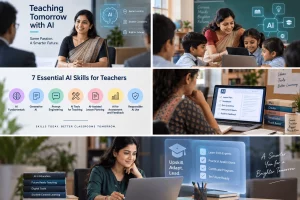
AI certification for teachers is no longer a future consideration; it is a present classroom need. As students across India are already using AI tools for assignments and projects, educators need practical training to guide that use responsibly. This guide covers what AI certification for teachers actually involves, how to choose the right course, and which programmes in India are worth your time in 2026.
Table of Contents
- Why Teachers Are Suddenly Talking About AI
- What “AI for Educators” Actually Means in Practice
- How to Choose the Right AI Certification
- Best AI Certification Courses for Teachers in India (2026)
- What Changes After You Get Certified
- Conclusion
- Frequently Asked Questions
1. Why Teachers Are Suddenly Talking About AI
Walk into any staffroom today, and you will hear at least one version of this conversation: “Students are already using AI, but we don’t even know where to start.”
This shift did not come from policy or curriculum updates. It came from classrooms. Teachers are noticing students submitting better-structured answers, faster project drafts, and sometimes work that feels slightly “off”. The question is no longer whether AI should be used. It is how teachers can guide its use without losing academic integrity.
Many schools are still reacting rather than preparing. That is where AI certifications for educators are starting to matter. Not as a technical upgrade, but as a classroom survival skill.
2. What “AI for Educators” Actually Means in Practice
AI for educators refers to practical training that helps teachers use AI tools responsibly for lesson planning, assessment, differentiated learning, and classroom support. Good programmes focus on AI literacy for teachers, responsible AI in education, and real classroom application rather than coding or technical expertise.
There is a misconception that AI training for teachers is about coding or complex tools. In reality, most teachers need something far more grounded.
In a typical classroom, AI shows up in simple ways:
- A teacher uses AI tools for Indian classrooms to generate differentiated worksheets for mixed-ability learners
- A language teacher refines writing prompts to push critical thinking
- An academic coordinator uses AI to draft assessment rubrics faster
- A teacher checks AI-generated student submissions for originality and depth
Good AI training does not overload teachers with tools. It focuses on decision-making. When to use AI, when to avoid it, and how to apply responsible AI in education without reducing learning quality.
The best courses acknowledge a simple truth. Teachers do not need to become AI experts. They need to become confident users with strong AI literacy for teachers.
3. How to Choose the Right AI Certification
Not all AI courses for teachers are built the same. Some are too technical, while others stay too theoretical.
Here are a few things that actually matter when choosing a course:
- Classroom relevance: Does the course show real teaching scenarios or just tool demonstrations
- Time flexibility: Teachers are already stretched. Short, modular learning works better
- Ethical guidance: Clear boundaries on student use, plagiarism, and assessment design
- Practical outputs: Lesson plans, prompts, or strategies you can use immediately
- Support system: Access to a peer group or mentor helps more than recorded videos alone
A quick test is this. After completing the course, can a teacher walk into class the next day and try something new without hesitation?
If the answer is no, the course may not be worth the time.
See if the IITED AI for Educators course fits your classroom and school needs
4. Best AI Certification Courses for Teachers in India (2026)
India has seen a rise in AI-focused teacher training, but only a few are aligned with actual classroom needs.
One course that stands out is the AI for Educators programme by IITED.
What makes it different is its grounding in real teaching contexts. Instead of focusing only on tools, it walks teachers through situations they already face. For example, how to redesign homework when students have access to AI, or how to create assessments that test thinking rather than output.
The course is structured in a way that respects a teacher’s schedule. Short modules, practical assignments, and clear applications make it usable rather than overwhelming.
Other available options in India include:
- General AI awareness courses on platforms like Coursera or edX, which are useful but often not tailored to school environments
- Workshops conducted by private EdTech companies, which vary widely in quality and depth
The gap in many of these is context. They explain AI well, but not teaching.
That is where educator-specific certifications, like the one from IITED, are gaining attention.
5. What Changes After You Get Certified
The real impact of an AI certification is not visible in certificates or portfolios. It shows up in small classroom shifts.
A teacher who was once hesitant starts experimenting.
Assignments become slightly more thoughtful.
Questions in class become more open-ended.
There is less fear and more curiosity.
One noticeable change is how teachers respond to AI-generated work. Instead of rejecting it outright, they begin to probe deeper. “How did you arrive at this answer?” becomes a more common question than “Did you use AI?”
This shift reflects growing AI literacy for teachers and a better understanding of how responsible AI in education should work in practice.
At the school level, academic leaders start rethinking policies. Not banning AI, but integrating AI tools for Indian classrooms in more structured and meaningful ways.
This is where trained teachers make a difference. They move the conversation from control to guidance.
6. Conclusion
AI is already part of the classroom, whether schools acknowledge it or not. The real question is whether teachers feel equipped to handle it.
An AI certification is not about staying current with technology. It is about staying relevant as an educator.
For teachers and school leaders in India, choosing a practical, classroom-focused programme like IITED’s AI for Educators course can be a strong first step. Not because it promises transformation, but because it builds clarity where there is currently confusion.
7. Frequently Asked Questions
- What is an AI certification for teachers?
It is a training programme that helps teachers understand and use AI tools effectively in teaching, assessment, and classroom management. - Do teachers need technical knowledge to learn AI?
No. Most AI for educators courses are designed for non-technical users and focus on practical applications. - How long does an AI certification course take?
It varies, but most educator-focused programmes range from a few weeks to a couple of months with flexible schedules. - Is AI allowed in classrooms in India?
There is no universal policy yet. Schools are gradually developing their own guidelines, which makes teacher training even more important. - How can AI improve student learning?
AI can support personalised learning, faster feedback, and better resource creation, but it needs to be used thoughtfully. - Which is the best AI course for teachers in India?
Courses that focus on classroom application are most useful. IITED’s AI for Educators programme is one such option designed specifically for teachers. - Is AI certification recognised in India?
AI certification for teachers is not regulated through a single national framework yet, but many schools and educational institutions increasingly value educator-focused AI training. Programmes that focus on practical classroom application, responsible AI use, and teacher workflows are gaining stronger recognition across Indian schools and academic networks.