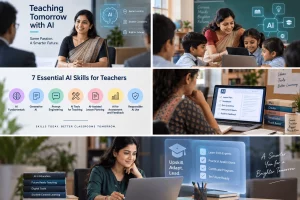
A teacher AI course helps educators use artificial intelligence tools confidently for lesson planning, assessment, differentiated learning, and classroom support. Designed for non-technical users, these courses focus on practical classroom application, AI literacy for teachers, and responsible use of generative AI in education rather than complex technical training.
Table of Contents
- Why Teachers Are Turning to AI
- What a Teacher AI Course Actually Teaches
- Where Most Teachers Get Stuck
- Starting Small in Real Classrooms
- Choosing the Right Teacher AI Course
- Making AI Part of Everyday Teaching
- IITED’s AI for Educators Course
- Frequently Asked Question
1. Why Teachers Are Turning to AI
Walk into a staffroom today, and you will hear a mix of curiosity and hesitation around AI.
One teacher is experimenting with ChatGPT to generate worksheets. Another is quietly worried that students are already using it to complete assignments. A third has bookmarked five AI tools but has not opened any.
The pressure is not abstract. Teachers are already dealing with:
- Increasing administrative workload
- Diverse learning needs in one classroom
- Expectations to integrate technology without clear training
AI feels like both a solution and a risk.
This is where a structured teacher AI course becomes useful, not as a trend to follow, but as a way to regain control over how AI fits into teaching practice.
2. What a Teacher AI Course Actually Teaches
Many assume a teacher AI course is mainly about tools. It is not.
The more useful programmes focus on how generative AI in education fits into the teaching process itself. They help educators build AI literacy for teachers while developing practical classroom confidence instead of depending blindly on outputs.
A strong programme typically covers:
- How AI generates content and where it can go wrong
- Designing prompts that actually produce usable teaching material
- Using AI for lesson planning without losing curriculum alignment
- Supporting differentiated learning without doubling the workload
- Identifying ethical concerns, especially around student use
- Understanding AI pedagogy and where human judgement remains essential
For example, instead of asking AI to “create a lesson plan on fractions”, a trained teacher might prompt:
“Create a 40-minute lesson plan on fractions for Grade 4 students who struggle with basic division, include one hands-on activity and one formative assessment.”
The difference in output is immediate. This is the kind of shift a good teacher AI course builds.
3. Where Most Teachers Get Stuck
In practice, most teachers do not struggle with using AI tools. They struggle with trusting them.
A common pattern looks like this:
- The teacher generates a worksheet using AI
- They spend more time correcting it than expected
- They conclude it is faster to do it manually
This usually happens because the AI output is not aligned with classroom realities. It may:
- Miss the level of the students
- Ignore the school’s curriculum sequence
- Use examples that do not fit the local context
Without training, AI becomes an extra layer of work rather than a support system.
See how IITED’s AI for Educators course helps teachers move past experimentation and into confident classroom use.
4. Starting Small in Real Classrooms
The teachers who successfully adopt AI do not overhaul everything. They start with one friction point.
In many schools, that point is assessment.
A teacher might begin by:
- Generating 3 variations of the same question for mixed ability groups
- Creating quick exit tickets at the end of a lesson
- Drafting feedback comments for common student mistakes
One middle school teacher used AI only for rephrasing questions. Nothing else. Within a week, she had a bank of differentiated questions that previously took hours to prepare.
The key is not scale. It is consistency.
5. Choosing the Right Teacher AI Course
Not all courses are designed for real classrooms.
When evaluating a teacher AI course, it helps to look beyond the tool demonstrations.
Focus on whether the course:
- Uses classroom-based examples rather than generic scenarios
- Addresses actual teacher workflows like planning, assessment, and feedback
- Encourages critical thinking about AI outputs
- Provides guided practice, not just explanations
This is where programmes like IITED’s AI for Educators course stand out. It is built around how teachers actually work, not how AI tools are marketed.
Instead of overwhelming educators with features, it walks through practical use cases that can be applied immediately in classrooms.
6. Making AI Part of Everyday Teaching
The real shift happens when AI stops feeling like an experiment.
It becomes part of routine decisions:
- Drafting lesson hooks while having morning tea
- Adjusting questions during a free period
- Preparing revision material before exams
At this stage, teachers are not asking “Should I use AI?” They are deciding, “Where does AI save me time without compromising quality?”
This is where AI literacy for teachers becomes important. The goal is not dependence on tools, but developing enough confidence to apply AI pedagogy thoughtfully in everyday teaching.
Good teachers do not hand over control to AI. They use generative AI in education as a starting point. They edit, adapt, contextualise, and align outputs with their students’ actual learning needs. Professional judgement remains central.
7. IITED’s AI for Educators Course
A teacher AI course is not about keeping up with technology. It is about reducing friction in everyday teaching.
Start with one use case. Learn how to guide the tool properly. Build from there.
IITED’s AI for Educators course is designed to bridge the gap between curiosity and confident classroom use. It moves beyond surface-level tool exploration and focuses on how AI fits into real teaching workflows. Teachers are guided through practical scenarios such as planning lessons, creating differentiated materials, and managing assessments with AI support.
The course also builds confidence in evaluating AI outputs, so educators can adapt them to their students’ actual learning levels rather than relying on generic responses. For schools looking to introduce AI in a structured and meaningful way, it provides a clear starting point that aligns with everyday classroom realities.
The goal is simple. Less time on repetitive tasks, more time on actual teaching.
8. Frequently Asked Questions
- What is a teacher AI course?
A teacher AI course trains educators to use artificial intelligence tools for lesson planning, assessment, feedback, and classroom support in a practical and ethical way. - Do teachers need technical knowledge to learn AI?
No. Most courses are designed for non-technical users and focus on practical application rather than programming. - How can AI help in daily teaching tasks?
AI can support lesson planning, generate worksheets, create differentiated content, and assist with feedback, reducing preparation time. - Is AI reliable for creating teaching materials?
AI can be helpful but requires teacher review. Outputs need to be checked for accuracy, level, and relevance to the curriculum. - Which is the best teacher AI course?
The best course is one that focuses on real classroom use. IITED’s AI for Educators course is designed specifically for teachers and school environments. - Will AI replace teachers in the future?
No. AI can support teaching tasks, but it cannot replace the judgment, empathy, and adaptability that teachers bring to the classroom. - How long does a teacher AI course take?
The duration depends on the programme. Many practical teacher-focused AI courses are designed to be completed within a few hours to a few weeks. IITED’s AI for Educators course, for example, is structured as a flexible 21-hour programme that teachers can complete at their own pace.